|
iHi
An iHi guide page. A discovery of the real Spain, far from the tourist crowds |
Selected
independent hotels with character
|
 |
|
Spain for discerning travellers
|
||||
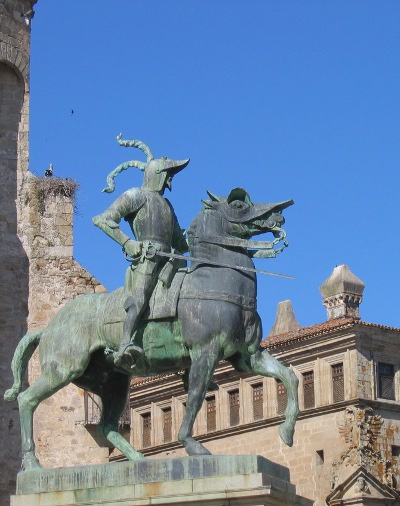 Trujillo - bronze statue of the conquistador Francisco Pizarro This page is about the Spain that most tourists never visit – the Spain of vast open spaces, mountains and nature reserves, historic towns and villages, amazing castles and walled cities, ancient churches, monasteries and chapels, and a cultural history that is a fusion of three great religious heritages, Christianity, Judaism and Islam. Nowhere else in Europe did these three cultures come together as they did in Spain - a fact that helps to make Spain such a unique country with so much to offer the intelligent traveller. Obviously, no parts of Spain are really "undiscovered", and few are totally off the tourist trail; but in many parts of Spain, tourism is almost exclusively Spanish - in excess of 90% even in some places that have everything to offer, including history, monuments, natural environment and accommodation. Extremadura If it were possible to designate a "capital" of undiscovered Spain, it would have to be the region of Extremadura - a region so undiscovered that few people outside Spain have ever heard of it. Located getween Castile and the Portuguese border, this is a large sparsely populated region - larger than Belgium - that can boast three UNESCO world heritage sites, other European heritage sites, plus several natural heritage areas - not to mention little towns and villages with remarkable features that are not even mentioned in local guide books. In the 16th century, most of his courtiers were surprised when the great Hapsburg Emperor Charles V - born in the Netherlands - chose to spend the last years of his life in a monastery in Extremadura; but the few tourists who visit the former monastery at Yuste should not find it difficult to understand. Most of Extremadura's few towns are worth a visit. Merida, with its fine Roman remains that are among the best in Spain, Caceres with its unique Renaissance cityscape, Placensia with its walls and its fine cathedral, Trujillo - surely one of the most  interesting
and attractive small towns in Spain. East of Trujillo, in the sierra
for which it is named, lies the Royal Monastery of Guadalupe, one of
the finest in Spain, and another world heritage site; as well as its
impressive architectural ensemble, the monastery contains many works of
art by Spain's greatest artists. Obviously, these towns and monuments
are at in the tourist guides; but the same cannot be said for
plenty of other interesting spots, beautiful
small towns like Garovillas,
with its large whitewashed arcaded plaza,
or Galisteo,
a small town completely encircled by intact
mediaeval ramparts. interesting
and attractive small towns in Spain. East of Trujillo, in the sierra
for which it is named, lies the Royal Monastery of Guadalupe, one of
the finest in Spain, and another world heritage site; as well as its
impressive architectural ensemble, the monastery contains many works of
art by Spain's greatest artists. Obviously, these towns and monuments
are at in the tourist guides; but the same cannot be said for
plenty of other interesting spots, beautiful
small towns like Garovillas,
with its large whitewashed arcaded plaza,
or Galisteo,
a small town completely encircled by intact
mediaeval ramparts.As for the natural environment, Extremadura with its parks, mountains, hiking trails, cycling trails and vast open spaces, is a region where getting away from the crowds is a way of life. While the mountains and valleys of the Monfrag�e national park are attracting a growing number of visitors on account of their relatively easy accessbililty from the Madrid-Lisbon motorway which passes through Extremadura, the Sierra de Gata, close to the Portuguese border, is an area that is about as remote as any you can find in Europe. Both of these areas - as indeed the whole of Extremadura - offer marvellous opportunities for outdoor pursuits, and notably bird-watching; storks are everywhere - but the region is also home to many types of falcon, eagle and vulture, great bustards, blue magpies, and a huge variety of smaller birds. Castile The ramparts of Avila Salamanca, Segovia, Avila, and Todedo are four cities with a fabulous cultural heritage, and all classed as UNESCO world heritage sites. Salamanca, seat of one of Spain's greatest and most historic universities, boasts a magnificent cathedral and Plaza Mayor. Segovia, at the foot of the Sierra Guadarrama, is a beautiful old city with castle, cathedral, old city and the finest Roman aqueduct in Europe. Avila has the greatest, best preserved and most complete set of city walls in Europe, as well as a magnificent cathedral. As for Toledo, built on a hill in a bend of the River Tagus (Rio Tajo) and once the capital of Spain, the city is like a living museum of the history of Spain. A Roman bridge, Moorish monuments from the Middle Ages, the oldest synagogue in Europe, wonderful examples of Mudejar architecture - that uniquely Spanish blend of European and Moorish styles, a gothic cathedral and several late Renaissance monuments are among the many sights that have drawn in travellers for hundreds of years. Toledo was for a long time home to one of Spain's greatest artists, El Greco, and the city's El Greco museum has a fine collection. But beyond these centres, Castile has much more to offer, including countless sites and sights well off the beaten track. While a few sites like the stunning romanesque monastery of Santo Domingo de Silos, near Burgos attract large numbers of tourists - mostly Spanish or pilgrims - many other magnificent fortresses and beautiful mediaeval churches, though preserved and often well renovated, have very few visitors. Medina del Campo, on the plains of northern Castile, has one of the largest and finest Mudejar fortresses in Spain: but get further off the beaten track, just wander along the byroads of Castile, and marvel at the great castles or fine churches that grace sleepy villages and small towns that see few visitors. There is now way to list them all, as in Extremadura many fine historic monuments do not even get a mention other than in the most local of local tourist offices - and even then, not always. Visiting hidden Castile is journey of discovery from which the traveller can return with unique stories. Other parts of Spain
Coastal
areas of Spain
Along Spain's Mediterranean coasts,
there is precious little left that could be in any way described as
"off the beaten track". However, the designation, though
late, of a few natural heritage areas has helped protect a few parts of
the Mediterranean coast from the ravages of often uncontrolled
urbanization. Between the French border and Roses, on the Costa Brava,
the Cap de Creus natural park is one relatively accessible area of
protected coastline. South of Tarragona, the natural park of the Ebro
delta has preserved wetlands and traditional agriculture, as well as
some pleasant stretches of sandy beach. Three areas
of natural park have conserved quite a few kilometres of
coastline and direct hinterland between the beautiful walled city of
Peniscola and Torreblanca - after which the coast is fairly intensely
developed as far as Cartagena. In eastern Andalusia, the small Natural
park of Cabo de Gata - Nijar is an area of peace and quiet between
areas of intensive deveolpment - but also the site of intense legal
battles between promoters and conservationists. After that,
from Nerja to Gibraltar, the coast is almost permanently bordered by
motorways, main roads and their accompanying developments.
Spain's northern coast is a different story; though quite developed between the French border and after Bilbao, the western half of this coast still has traditional villages and fishing ports, with beaches and coves some of them only accessible on foot or along unmade tracks More
ideas for discovering Spain off the beaten path coming
soon. Including
more on the north coast of Spain, inland Andalucia and Valencia, the
Spanish Pyrenees, and other little visited areas
Driving off the beaten track in Spain In Franco's days, Spain had a network of main roads, and
little else; many small towns and villages could not be reached other
than on unpaved roads or terribly potholed sideroads. That was just
forty years ago. Today, Spain probably has one of the best road
networks in the world; beautifully built and surfaced roads criss-cross
the country, reaching into some of its deepest corners. And the
greatest joy is that very often, other than in the densely populated
areas round Madrid and on the coast, there is little or no traffic on
them.
In Franco's days, Spain had a network of main roads, and
little else; many small towns and villages could not be reached other
than on unpaved roads or terribly potholed sideroads. That was just
forty years ago. Today, Spain probably has one of the best road
networks in the world; beautifully built and surfaced roads criss-cross
the country, reaching into some of its deepest corners. And the
greatest joy is that very often, other than in the densely populated
areas round Madrid and on the coast, there is little or no traffic on
them.Furthermore it is possible to drive "off the beaten track" even between cities. Over the last half century, most main Spanish roads have been upgraded not just once, but twice or three times. And unlike in more populated countries, where upgrading means improving the existing road, the Spanish solution has often just been to build a new road near the old one. Consequently, on some routes, there are actually three parallel roads, the historic route, the post-Franco new road, and the more recent "autovia" divided highway. Where - as in most cases - the autovia is free, that leaves the old main road as empty as the most minor of minor cross country roads. Just occasionally, old main roads have been downgraded and /or equipped, as in France, with speed bumps and other devices - notably at the entrance to small towns; but generally speaking this is not the case. On cross-country routes, those that are not part of the national highway network designated as "N" roads, traffic in most parts of Spain is very light. The majority of minor roads, those linking villages and small towns, are very well built and modernised, even when they serve no more than a few hundred vehicles a day. And signposting on Spanish roads is generally excellent. As for motorways, these in Spain come into two categores; the busy to very busy ones - often toll roads - radiating from Madrid, and along the Mediterranean coast: and the others, most of them carrying only light traffic. Nearly all of these are free. AccommodationWhile the cities of Spain all offer a good choice of hotels - often of very good quality - the choice in rural areas and small towns is often more limited, and more varied. As well as hotels (sp." Hoteles"), there are also "hostales", which are small hotels usually with limited services, but often very pleasant and friendly places, and "pensiones", sign a "P" on a blue background, which are small guest houses or lodging houses, and usually very cheap. Even in 2022, a night in a rural pension may cost as little as 25 €uros - though the bathroom will probably be shared and the decor may well be old-fashioned.In the country, accommodation can often be found in the form of "Casas rurales", which can be anything from the equivalent of French g�tes, to bed and breakfasts, or even rural hostels for hikers. While most casas rurales are reasonably cheap, this is not always the case, and some custom-built casas rurales definitely target the upper end of the market, with upmarket facilities and prices to go with them. Some
useful sources of accommodation information:
|
iHi
Selected independent hotels with character in Spain
 Text and all photos on this page copyright� Independent-hotels.info Click for Undiscovered France Accommodation
in rural Spain: check out the Gitelink
directory
of holiday
cottages gites
and B&Bs
many with English-speaking owners 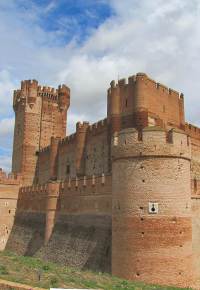 Mudejar fortress at Medina del Campo, Castile 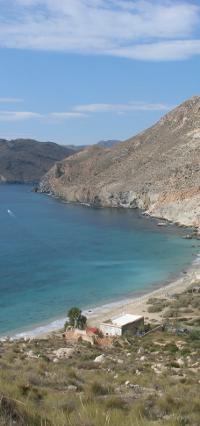 Off the beaten track on the Spanish coast |
|||
|
|
||||